PJA is pleased to announce its appointment by the Puffing Billy Railway Board (PBRB) to provide traffic and civil engineering advice for the Puffing Billy Railway Belgrave Precinct Key Area Plan (KAP). 

Supported by the Enabling Tourism Fund, the KAP will establish a strategic framework for future capital works at Puffing Billy Railway’s primary visitor hub, helping to meet growing visitor demand while preserving the heritage character of this iconic destination. 

The Belgrave Precinct presents a range of opportunities and challenges, including steep terrain, complex circulation requirements and interfaces with surrounding residential and commercial areas. PJA’s role focussed on delivering integrated traffic and civil engineering advice to support a safe, accessible and resilient precinct. 

Our traffic engineering team provided guidance on visitor circulation, passenger pick-up and drop-off arrangements, parking, accessibility and improved connections between the Metro Station, car parks and railway platforms.  

PJA’s civil engineering team provided high-level advice on site conditions, drainage, grading, earthworks and infrastructure requirements, helping to inform practical and deliverable precinct concepts. Working closely with the broader consultant team, we will support the development of solutions that balance accessibility, visitor experience, operational needs and environmental outcomes. 

We are proud to be contributing to the future planning of one of Victoria’s most recognised tourist attractions and look forward to supporting the delivery of a vibrant and sustainable precinct for visitors and the local community. 

Find out more about us here

Sign up for more news from PJA here

Get in touch

For more information please contact:

As PJA expands its presence in Australia, we are excited to introduce two new additions to our growing team – Denmark Yuzon and Zara Xie, both based in Melbourne.

We sat down with these new team members who bring knowledge and capacity to PJA’s growing Australian team to discuss their experiences, expertise, and ambitions. Here, they share their insights on joining the team and their fresh perspectives on the future of transport and engineering in the regions.


Denmark Yuzon, Senior Engineer, Melbourne

Denmark, welcome to PJA! What motivated you to join the team? 

PJA’s diverse project portfolio stood out to me, as it allows engineers to contribute across multiple disciplines and project types. The wide variety of projects not only supports professional growth but also encourages solutions that go beyond standard or habitual approaches.

Equally important to me is workplace culture. From my interactions and observations, PJA has a genuinely warm, collaborative, and welcoming culture where people support each other and value teamwork. That combination of technical opportunity and positive culture strongly aligned with what I was looking for, and ultimately motivated me to join the team.


You’ve delivered transport projects across Australia, New Zealand, Guam and the Philippines — how have these different environments shaped your approach to civil design and problem-solving? 

Delivering transport projects across countries has significantly shaped how I approach civil design and problem‑solving. Working in these different environments has broadened my understanding of how road design and infrastructure must respond to local conditions, whether its urban density, user behaviour, or levels of network maturity.

Exposure to diverse design standards, approval processes, and regulatory frameworks has strengthened my ability to understand what is required and adapt my approach accordingly. It has helped me become more efficient in navigating varying technical expectations while still maintaining safety, constructability, and compliance at the core of my designs.

Working across different cultures has also influenced how I think about design solutions. Cultural context often affects how infrastructure is used and perceived. Experiencing this first-hand has encouraged me to think more openly and explore alternative or innovative solutions where standard approaches may not be the most effective.


What aspects of the design process do you find most rewarding, and why?

The point where the geometry and the model truly come together. There’s a sense of satisfaction when the proposed contours are clean, smooth, precise and when the model reflects exactly how I envisioned my design would be.

I’m also motivated by the challenge of fitting new vertical and horizontal geometry into existing conditions. Achieving a solution where the proposed alignment works with constraints such as topography, tie‑ins, services, surrounding infrastructure and complies with design standards is especially rewarding. When a design balances compliance, functionality, and minimal disruption to existing conditions, it shows how effective the engineering behind the design is.


You’ve led multidisciplinary teams on major transport programs — what do you think makes collaboration successful on complex infrastructure projects? 

I believe successful collaboration on complex projects starts with strong coordination between all disciplines. Everyone needs to understand how their work connects to others, and regular communication is key to avoiding gaps or surprises. Just as important is having an open mindset and a culture that genuinely supports teamwork. On large projects, success is shared, if one part of the team struggles, it affects everyone, and when things go well, the whole team looks good.

I also think it’s important to recognise that there’s rarely only one right solution. Good collaboration allows different ideas to be explored and helps the team agree on the most practical and efficient way forward together.


Zara Xie, Civil Engineer, Melbourne 

Zara, it’s great to have you on board! What drew you to PJA?  

I was motivated to join the team because of the opportunity to contribute to meaningful work while continuing to grow professionally. The team’s focus on collaboration, innovation, and delivering high-quality results really stood out to me. I was particularly drawn to how my skills and experience align with the team’s goals, and I saw a chance to make a tangible impact while also learning from talented colleagues. Being part of an environment that values both performance and development was a strong factor in my decision.


You’ve worked across a wide range of sectors, from public domain to high-rise and aged care — what draws you to such diverse projects, and how does that variety influence your work?  

Each project type comes with its own set of challenges, stakeholders, and design considerations. That variety keeps the work engaging and pushes me to think more broadly and creatively. It also strengthens my ability to transfer knowledge between sectors. Working across different sectors makes me a more adaptable and well-rounded designer.


You’re passionate about development applications and detailed design — what do you enjoy most about this stage of a project?  

That’s where ideas are rigorously tested and refined into something buildable. It’s the point where design intent meets real-world constraints—planning controls, regulations, budgets, and construction requirements. I enjoy navigating that complexity and finding solutions that satisfy both compliance and design quality. There’s a real sense of achievement in resolving details, coordinating with consultants, and knowing that the work you produce directly shapes what will be constructed.


With your focus on technical problem-solving and attention to detail, what motivates you to consistently deliver high-quality outcomes? 

My motivation comes from a strong sense of responsibility to the project, the client, and the end users. I take pride in producing work that is not only technically sound but also thoughtful and well-resolved. Attention to detail is important to me because small decisions can have a significant impact on the overall success of a project. I also genuinely enjoy problem-solving—working through technical challenges, identifying potential issues early, and developing clear, efficient solutions. That combination of pride, curiosity, and accountability drives me to maintain a high standard in everything I do.


With Denmark’s expertise in transport infrastructure design and geometric modelling, and Zara’s broad experience across public and private sector developments with a strong focus on detailed design and water quality, PJA’s Australian team is further strengthened. Their technical capability, attention to detail, and commitment to high-quality, well-resolved outcomes are already adding value to our work. We are proud to welcome both Denmark and Zara as we continue to expand PJA’s presence in Australia, building a collaborative team committed to delivering excellence across diverse and complex projects. 

Melbourne Office

Level 19
15 William Street
Melbourne
VIC 3000
Australia

T: 0370 330 210
[email protected]


Find out more about us here

Sign up for more news from PJA here

In the race to cut carbon, the conversation often gravitates towards big moves: fleet electrification, flagship cycling schemes, low-carbon materials. These are important, but they’re not where most carbon is actually locked in.

For civil engineers, the most influential carbon decisions are often the smallest and least visible, made quietly at concept stage and treated as routine. Junction radii, kerb types, sub-base depths, parking ratios, earthworks profiles and drainage approaches may seem insignificant individually, but together they define a scheme’s carbon trajectory for decades.

This is why the difference between high and low-carbon design isn’t just about process – it’s about culture. Organisations that take a fundamentally different design approach, such as PJA, consistently deliver carbon-efficient, people-centred outcomes because of how they think, not just what they specify.

Small Decisions, Big Carbon Impacts

Civil engineering design is full of inherited defaults that rarely appear in carbon strategies but shape every project. These are not technological issues. They are matters of engineering judgement:

Over-specification

Over-specification is often hidden in geometry. Designers default to wider lanes, larger junction radii, excessive visibility and oversized roundabouts. Each choice increases surface area, pavement depth, lighting, and earthworks, yet many can be reduced without compromising safety when design speed and context are properly considered.

Similarly, pavement and sub-base thicknesses are frequently increased “just to be safe.” Small additions – millimetres at a time – quickly scale into significant volumes of aggregate, asphalt, transport movements and embodied carbon. Small reductions compound significantly across large schemes.

Questioning whether a junction needs to be signalised at all can avoid significant amounts of steel, ducting and long-term maintenance emissions.

Right-sizing infrastructure

High parking numbers lead to larger impermeable areas, more drainage systems , more excavation and long-term carbon-heavy car dependency.  When parking is right-sized to the context, carbon drops instantly.

Tightening junction radii by even one or two metres reduces asphalt, drainage extent, excavation and design speeds, with knock-on operational benefits. Challenging lane widths and designing to the context shrinks the overall footprint and reduces material use and lighting demand.

Early considerations

Drainage design often defaults to piped systems, carrying high embodied carbon in concrete and PVC. By contrast, implementing SuDS can reduce materials, excavation, and maintenance while improving biodiversity – but only if space is planned for them early.

Even earthworks are frequently left too late. Designing vertical alignments to follow the landform can eliminate large volumes of cut and fill, along with the need for retaining structures and material transport.  Minor alignment changes can be made at concept stage, but once geometry is fixed, the opportunity is lost.

Early engagement with manufacturers can also unlock lower-carbon materials and alternatives, avoiding decisions driven purely by habit.

Why Culture Matters More Than Process

The hidden carbon cost of “business as usual” isn’t caused by a lack of standards or tools – it’s caused by a lack of attention to the unobvious decisions that quietly shape a project’s footprint. Whilst processes and checklists can encourage early carbon thinking, they cannot replace a culture that empowers designers to challenge norms

By putting active travel at the centre of design, PJA have created a culture where:

  • Standards are interrogated, not blindly applied
  • Junctions start compact and grow only if justified
  • Land is allocated to people first, vehicles second
  • Carriageway space is treated as finite and expensive
  • Designers feel confident explaining why a smaller, simpler layout is better

True carbon leadership is not loud, it’s meticulous. And it’s found in the thousands of small decisions that only skilled civil engineers know how to make. This culture doesn’t just support low-carbon design – it makes it unavoidable.

Find out more about us here

Sign up for more news from PJA here

Our wonderful team are our greatest asset. Not only experts in transport, engineering and placemaking but also committed to delivering better places for people through high-level-service client experiences.

We’re very proud to continue to celebrate the faces behind the fast-growing international consultancy that we are today in our monthly feature ‘PJA People’.

Next up in our series is Graduate Geo-Environmental Engineer, Ailsa Reid, based in our Birmingham office:


Tell us what you do at PJA

I’m a graduate Geo-Environmental Engineer, working as part of PJA’s Ground Engineering and Contaminated Land team. My role involves a mix of office-based report writing and site-based work including water monitoring, site walkovers and ground investigation supervision.


What’s your career path so far?

I graduated from Lancaster University in the summer with a BSc in Earth and Environmental Science. As part of my degree, I completed an industry placement year in a geotechnical role with a large consultancy. I found the work interesting and knew I’d like to apply for similar roles after graduating, leading me to join PJA in September 2025.


What do you enjoy when you’re not working?

Not particularly surprising for a geologist but I love being outdoors! I spent a lot of time in the Lake District while I was in Lancaster and love to go hiking while travelling abroad.


Are you a dog or cat person?

A cat person, although my parents cat (Bertie) is always trying to get into nuisance!


What are you currently reading or listening to?

I love music and have quite a broad taste but am currently listening to a lot of Florence + The Machine in preparation for her tour.

Reading more often was one of my New Year’s resolutions, and because I enjoy murder mysteries, particularly from the golden age of detective fiction, I am currently reading a Miss Marple novel.


Claim to fame?

Difficult question! I don’t know anyone famous but did see Claudia Winkleman filming in Grand Central, Birmingham a couple of weeks ago.


Ailsa Reid, Graduate Geo-Environmental Engineer

Ailsa joined the PJA Graduate Development Program in September 2025 and is based in our Birmingham office. She recently graduated with a BSc in Earth and Environmental Science from Lancaster University and completed an independent geologic mapping project for her undergraduate dissertation.

She has a year of experience in geotechnical consultancy, and has produced geotechnical and geo-environmental reports. She has site-based experience including site walkovers and ground investigation supervision.

Get in touch with Ailsa: [email protected]


Find out more about our services here

Read more in our PJA People series here

Sign up for more news from PJA here

It’s been six months since Gary Soo joined our Perth office, and in that time, his extensive experience in transport modelling and traffic engineering has already made a significant contribution. 

With over 12 years in the transport engineering field, Gary brings specific skillset in future scenario testing, blending technical precision and practical thinking. His background spans greenfield masterplan development to complex urban redevelopments. Across each of these settings, he has maintained a sharp focus on data-driven solutions that are commercially attuned and grounded in real-world functionality. 

At PJA, Gary has been applying his modelling expertise to the ongoing development of Alkimos Central which he has worked on for almost a decade through the various planning stages. More recently, Gary has embarked on the Busselton Gateway Industrial Park, helping shape transport outcomes that are not only efficient but also sustainable and user-focused. His ability to translate modelling insights into clear, actionable design advice has quickly become an asset to both colleagues and clients. 

“I’ve always believed that good transport planning doesn’t happen organically, it requires innovative thinking and collaborative working. At PJA, there’s a shared commitment to that philosophy, and it’s been great to work alongside a team that values evidence-based, outcomes,” says Gary. 

Gary’s experience in complex transport simulation and traffic analysis brings an analytical depth that complements PJA’s broader placemaking thinking. As transport challenges across Australian cities grow more interconnected and nuanced, voices like Gary’s, with a focus on practical implementation, are essential in helping PJA shape the cities of the future. 

We’re excited to have Gary on board as we continue to deliver thoughtful, people-first transport solutions across Western Australia and beyond. 

Find out more about our services here

Sign up for more news from PJA here


Gary Soo, Senior Consultant

Gary brings over 12 years of experience in transport planning, traffic engineering, and transport/traffic modelling. He has worked across both the public and private sectors, contributing to intersection concept design, greenfield developments, and urban projects. His broad skill set includes preparing transport impact assessments, as well as conducting intersection and traffic signal analysis and concept design.

Gary is committed to delivering practical, effective solutions that help move people safely and efficiently.

Get in touch with Gary: [email protected]


Following his recent accreditation as a Healthy Streets Practitioner and Designer, Sam Williams, Director in our Melbourne office, shares his reflections on the role of civil engineers in creating healthier, more inclusive, and community-focused street environments:

This is more than another badge—it’s a meaningful step in rethinking how civil engineers contribute to placemaking and public health.

The accreditation builds on PJA’s commitment to create street environments that support healthier, more equitable and connected communities. I feel genuinely privileged to work alongside colleagues in Australia, and the UK, who are thought leaders in equitable access, safer speeds, and active travel—and challenge the status quo on every project.

This journey has been shaped by some excellent discussions—most recently at the Placemaking Summit 2025 in Melbourne. One comment that stuck with me was someone saying, “I’m not a placemaker.” But the truth is: everyone is. Whether you realise it or not, your work, your decisions, even your offhand comments all shape a place.

It’s often those who don’t see themselves as placemakers who can have the biggest impact—sometimes unintentionally. A passing remark like “the community wouldn’t accept that”—without speaking to the community. The specific location of signs reducing footpath widths during detailed design. Or opting for a standard guardrail outside a school, without considering the message that sends to children and carers.

Thanks to Lucy Saunders FFPH for leading a rigorous and thought-provoking course, and for continuing to push us all to consider how streets can better support human health and experience.

Looking forward to applying this learning in the streets we design and the conversations we shape.

Find out more about our services here

Sign up for more news from PJA here


Sam Williams, Director

Sam heads up the Melbourne office of PJA and has over 14 years’ experience in civil engineering design consultancies.

He has worked on a wide range of projects including: development infrastructure, public realm improvements, national cycle routes and urban regeneration.

Sam brings a genuine passion for early engineering engagement at concept stage to ensure that a creative and credible design can be delivered.

Get in touch with Sam: [email protected]


We’re pleased to welcome Simon Davies as a Director at our Melbourne office. With over 25 years’ experience in transport planning and engineering, Simon brings a wealth of knowledge developed across some of Victoria’s most high-profile projects.  

His appointment marks a key step in the continued growth of our Australian operations. 

Simon is a highly respected transport engineer and planner with a broad skill set spanning strategic planning, development access, built form integration, major event logistics, and expert advisory services. He has led multi-disciplinary teams for both public and private sector clients and is regularly called upon to present expert evidence at VCAT and Panels Victoria. 

Before joining PJA, Simon led the Melbourne office of a major consultancy, growing it to over 70 staff. He is known for his calm leadership, strong stakeholder relationships, and focus on achieving outcomes that balance movement, accessibility, and place. 

Simon has delivered transport plans for many of Australia’s most iconic events, including the Formula 1 Grand Prix, Phillip Island MotoGP, and the Australian Open. His project work also includes major developments such as Caulfield Village, Moonee Valley Racecourse, Craigieburn Town Centre, and the Berrybank Wind Farm. 

With deep knowledge of Victoria’s transport landscape and a passion for shaping more connected, people-focused places, Simon’s leadership will help us continue supporting clients across Australia with thoughtful, integrated transport solutions. 

Speaking about his appointment, Simon said: “I’m excited to join PJA and be part of a team that shares my commitment to high-quality, place-led transport planning. I look forward to working with our clients and colleagues to continue making a positive impact across Victoria and beyond.” 

Sam Williams, Director at PJA in Melbourne, noted that: “Simon’s appointment marks an exciting step in PJA’s continued national growth, particularly within Victoria. With an impressive track record, he brings added strength to our capabilities, and I look forward to working with Simon and the team to deliver exceptional outcomes for our clients across the country.” 

Find out more about our services here

Sign up for more news from PJA here


Simon Davies, Director

Simon is a highly accomplished transport engineer and planner with extensive experience across Victoria. He brings a broad and in-depth understanding of all aspects of transport and traffic engineering, and he leads multi-disciplinary transport teams for both private and public sector clients. Simon is regularly called upon to present expert evidence at the Victorian Civil and Administrative Tribunal (VCAT) and Panels Victoria.

He has also served as a trusted transport planning adviser for some of Australia’s largest and most iconic events, including the Melbourne Formula 1 Grand Prix, Phillip Island MotoGP, and the Australian Open Tennis.

Get in touch with Simon: [email protected]


As PJA expands its presence in Australia, we are excited to introduce two new additions to our growing team – Cameron Steel, based in Perth, and Pasan Bandara, based in Melbourne.

We sat down with these new team members who bring knowledge and capacity to PJA’s growing Australian team to discuss their experiences, expertise, and ambitions. Here, they share their insights on joining the team and their fresh perspectives on the future of transport and engineering in the regions.


Cameron Steel, Consultant Transport Engineer, Perth

Cameron, welcome to PJA! What motivated you to join the team? 

Thank you! Joining PJA felt like a natural step in my career. I had worked with many of the Perth team members in my previous role and knew their reputation in the W.A. industry for delivering innovative transport solutions. PJA’s collaborative environment and forward-thinking approach really appealed to me, especially as I want to contribute to projects that shape our cities for the future. 


Can you tell us about your background and areas of expertise? 

I’ve been working in engineering for over four years, primarily in transport engineering. I graduated from Curtin University in 2021 with a Bachelor of Engineering (Honours), majoring in Civil and Construction Engineering. My primary focus is on transport engineering, but my proficiency spans transport planning and analytics with key skills in technical writing, assessments, and data analysis. Through my project experience, I have developed relationships with a number of clients and delivered technical advice bespoke to their individual needs. I’m also working towards becoming a W.A. accredited Road Safety Auditor, which is an exciting goal for me. 


You’re involved in several industry groups. How has that shaped your work? 

I’m actively involved with Engineers Australia’s Transport Australia Society (TAs) and the Australian Institute of Traffic Planning and Management (AITPM). It’s helped me build a strong network of professionals, and being part of these groups keeps me informed on various emerging trends and best practices in the industry. I’m passionate about innovation and working with emerging transport professionals through these channels, and I was recently pleased to host TAs’ September Industry Hour which focused on ‘An Introduction to Placemaking on Transport Projects’. 


What excites you most about the future of transport engineering? 

I’m really excited about the shift towards more sustainable, smart transport solutions. The integration of data and technology into transport systems is changing how we think about movement, and it’s great to be at the forefront of that with PJA. 


Pasan Bandara, Civil Engineer, Melbourne 

Pasan, it’s great to have you on board! What drew you to PJA? 

Thanks! PJA stood out to me because of its multidisciplinary approach and focus on innovation. I’ve always been interested in how different aspects of engineering come together to create places and sustainable solutions, and PJA really champions that. Joining a team with such a strong commitment to integrating transport and place engineering felt like the right move for me. 


You have a dual focus on stormwater and transport engineering – can you tell us more about that? 

My background is in civil engineering, which I studied at Deakin University, graduating with honours in 2022. I’ve developed a strong foundation in stormwater design, surface modelling, and pavement design through Civil 3D. What excites me is combining these skills with place-led engineering, like street cross section designs, people focused developments and WSUDs. I’m passionate about finding ways to integrate solutions to make infrastructure both functional and environmentally sustainable. 


How do you see stormwater management and transport design working together? 

They’re deeply integrated as effective stormwater management is critical for enabling places. By integrating effective stormwater management with transport design principles, I hope to enhance project outcomes, contributing to safer, more functional and environmentally conscious infrastructure. Having a focus on the civil engineering aspects, such as WSUD during the initial design phases enables these features to be more viable and integrated in the design solutions.  


What do you hope to achieve at PJA? 

I’m excited to grow and contribute to projects that push boundaries. I hope to help drive forward projects that not only meet the immediate needs of communities but also ensure long-term sustainability. I’m always learning, and PJA’s collaborative environment is a great place to continue my development. 


With Cameron’s focus on transport engineering and Pasan’s expertise in stormwater design, PJA’s Australian team is strengthened. Their innovative approaches and dedication to sustainable, client-focused solutions are already making an impact, and they are set to contribute significantly to PJA’s future success. We are proud to welcome these talented professionals as we continue to expand PJA’s presence in Australia, building a team that is committed to delivering excellence multi-nationally. 

Perth Office

Quay Perth
18 The Esplanade
Perth
WA 6000
Australia

T: 0427 382 288
[email protected]


Melbourne Office

Level 19
15 William Street
Melbourne
VIC 3000
Australia

T: 0370 330 210
[email protected]


Find out more about us here

Sign up for more news from PJA here
International Women in Engineering Day shines a light on the amazing work women engineers are doing every day around the world giving them a profile when they are still hugely under-represented. With 2021 figures indicating that in the UK only 16.5% of engineers are women, the day offers the opportunity to encourage young women and girls into engineering careers.

PJA’s Engineer, Fel Llanora explains:

“As a female engineer who is in early years on my career, the gender ratio between male and female engineers is still unbalanced. From attending engineering lectures with a 70:30 ratio between men and women, to walking into male-dominant offices where women are minority, it can be quite intimidating, yet it can feel powerful at the same time.

“This issue has been improved over the past few years and I am hopeful that it will continue to do so. In order to do this, I believe that having fellow women promoting engineering to schools, social media platforms, etc., as well as advertising engineering opportunities by using a face of a woman, can be a great way to help encourage more females in join the industry and help close the gender imbalance gap.”

At PJA,  33.3% of our engineers identify as female meaning our team is much closer to the demographic we create solutions for than the industry standard. There’s still work to be done though by engineering as a whole to support underrepresented minorities. To do our bit on the 10th anniversary of INWED, we’re shining a spotlight on some very talented women engineers working at PJA:

Abbie Smart is a Principal Engineer with over 16 years’ experience in the civils and development infrastructure sectors. Abbie is keen to incorporate sustainable design solutions within her designs and passionate about delivering high quality work for her clients.

Alison Caldwell is a Chartered Civil Engineer in our water resources team. She actively champions holistic water management to ensure long term resilience of future development and has taken a lead role in delivery of multi-disciplinary projects across the UK and internationally.

Amy Bennett joined our Graduate Development Programme in January 2023 after graduating from University of Nottingham. As part of our water resources team, she is interested in flood risk and management strategies, helping clients to develop solutions for difficult projects.

Andrea Nelmes is a Chartered Flood Risk and Drainage Engineer. As a technical specialist in flood risk, river restoration, drainage strategies and SuDS design she provides responsive, pragmatic advice to clients.

As an expert in land contamination, Associate Charlotte Smith’s main interest is in the reclamation and remediation of brownfield sites where she has proven abilities in engaging key stakeholders and regulators and navigating the planning process to deliver land ready for development.

Charlotte Turner joined our Graduate Development Programme in 2021 after graduating from Coventry University. She has since developed a keen interest in natural flood risk management using her skills in GIS and hydraulic modelling to assess the impact of new development.

Fel Llanora is a Civil Engineer focused on highway schemes and improvements for development projects from preliminary stage through to construction. She is eager to promote women in STEM subjects, particularly towards the younger generation.

Holly Mullen is a Principal Consultant with 13 years’ experience in design and consultancy. She is an experienced engineer with skills predominantly in the design and delivery of walking and cycling infrastructure schemes from feasibility to construction.

Kayleigh McGeogh is a Geo Environmental Consultant focusing on ground investigation for potential development sites and has worked on a wide range of geo environmental and geo technical projects across the UK.

Nikki Slack is a Civil Engineer focused on highways and road safety engineering from initial site studies through to detailed design as well as infrastructure design for both residential and commercial developments.

Phoebe Ryding is a Chartered Water and Environmental Manager focused on developing surface water drainage strategies which holistically manage surface water through the use of SuDS. She also produces Flood Risk Assessments to support proposed development and works with local authorities and SuDS Approval Bodies reviewing applications.

Samantha Furey is a Civil Engineer focused predominantly on highways, drainage and earthworks design for residential projects throughout the project lifecycle. She is working towards becoming a Chartered Civil Engineer.

Sonja Townsend is a Principal Engineer working on multi-disciplinary projects from feasibility to construction stage. She is an experienced engineer with skills predominantly in public realm design, utility strategies and planning and technical support. She also takes concept schemes in to detailed design and prepares Transport Assessments and Travel Plans.

Find out more about our engineering services here

Sign up for more news from PJA here
20 minute neighbourhoods, we are all placemakers and “Farnarklin” – All covered in Day 2 of the Australian Placemaking summit 2022.

Following a very insightful first day from multiple industry leaders I was excited to attend Day 2 of the placemaking summit 2022. Day 1 helped establish the fundamentals of placemaking and how it has a significant impact on everyone’s lives. Day 2 expanded on this and even highlighted that if done well it can extend life expectancy!

The day kicked off with a keynote from Lucinda Hartley (Neighbourlytics) exploring the world of big data to provide alternative ways to score places using hyper-local analytics for 20 minute neighbourhoods backed by global research and coverage. The case studies from cities around the world explored the interaction between social life, wellbeing of places and citizen-centric design.

This presentation was followed by Peter Smith (City of Port Phillip) on the opportunities and challenges of Fishermans Bend, a development close to my heart being in my local neighbourhood.

Fishermans Bend is Australia’s largest urban renewal project covering approximately 480 hectares in the heart of Melbourne. The development will create employment opportunities for up to 80,000 people and provide approximately 80,000 homes by 2050.

Peter highlighted the importance of the three critical success factors, software, hardware and orgware. The concept of ‘orgware’ was new to me but one that will not be forgotten, orgware helps to provide the framework of a development and resonated with me as it ensures the place has a soul. You can build the best buildings, install the best features but without the place having a soul it will struggle with the test of time.

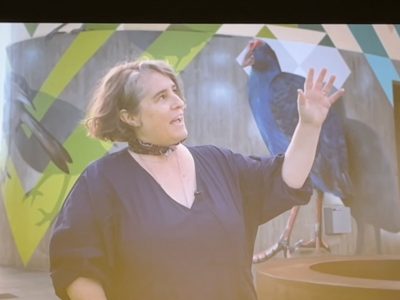
Frith Walker (Panuku Development) was unable to make the conference and pre-recorded a presentation, a masterclass of how to pre-record a presentation I must add! The passion Frith has for placemaking shone through into the room and had every attendee glued. Frith took us on a guided tour of a project across the ditch in Tāmaki Makaurau, a project that has been designed with a heart and encompasses one of the initial quotes:

“Hutia te rito o te harakeke
Kei whea to kōmako e kō?
Ki mai ki ahau
He aha te mea nui o te Ao?
Maku e kī atu,
he tāngata, he tāngata, he tāngata”

“If the heart of the harakeke was removed,
Where would the bellbird sing?
If I was asked what was the most important thing in the world
I would be compelled to reply,
It is people, it is people, it is people”

From an engineering perspective the development needed a pumping station, from a placemaking perspective the development embraced the requirement for a pumping station, seeing it as an opportunity to bring artwork into the community.

A panel discussion followed discussing placemaking and the property development, Sophie Pickett-Heaps (Stockland) stated they embrace placemaking and see it as a critical aspect in their role as developers. Afterall, they are not simply selling a product, they are first hand creating a community and lifestyle. Bec McHenry (To Good Use) provided a key take away comment; we should all call ourselves placemakers, not just Architects, Planners, Engineers etc.

This is a great way to break down the barriers and encourage collaboration, by each profession coming together with the one vision – to create a better place through great design. It just so happens this is the reason I joined PJA, to integrate all aspects of development!

Farnarkling?

I was then introduced to one of the most Australian words I have come across: ‘Farnarkling’ – The group activity whereby everyone sits around discussing the need to “do something” but nothing actually happens.

Bruce Mills (City of Parramatta) went on to explain how they have one of the largest local government place-making teams linking projects, initiatives and priorities across multiple business units.

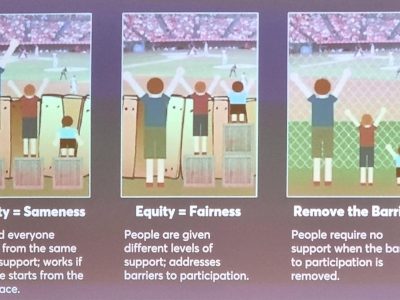
We have all seen the “Equality = Sameness and Equity = Fairness” image but the third “Remove the Barrier!” is rarely depicted, why can’t we just remove the barrier! Wouldn’t this create a world we can all celebrate? I believe the more conversations we have around inclusive design, collaborating between all professions and increased consultation with every stakeholder the outcomes can only ever be celebrated.

Are there other engineers at a placemaking summit you ask?

This time taking centre stage with a panel discussion: Placemaking and public lighting.

Highlighting the importance of lighting, not just on safety but the transition between space and creating places through light play. It was great to hear the passion from other engineering professionals to be included in initial designs and just how flexible lighting can be, not just fit for purpose but can be embraced. Why just design places for the day when dark occupies up to 50% of the time?

But…did I get questions answered?

So were my initial three questions answered on Placemaking?

• Is it implementing shared spaces and slowing vehicular traffic?
• Is it removing parking and encouraging active travel?
• Is it just another buzzword in the industry?

The answer is both yes and no to all three and that is ok.

Every presenter had a different definition of placemaking and that’s ok too, so long as we all have the ambition to create great places.

Afterall, we are all placemakers!


Got questions or fancy a conversation over a coffee? Get in contact as it would be great to keep the topic at the forefront of discussions.

For more information, please contact [email protected]

Find out more about us here