Don’t be afraid to say ‘I’m great at this’; learn everything you can from your colleagues, both junior and senior, and remember that women have an extremely valuable contribution to make.

Top advice from our engineering stars of today’s International Women’s Day celebrations: Project Manager Emma Wood and Flood Risk and Drainage Engineer Phoebe Ryding, both in our Birmingham office.


Emma Wood

What was your career path, how did you get to where you are today?

My career path is not typical of the engineering sector, I actually have a BA in Media & Society.  My degree taught me that the message you give is defined by those receiving it, not what you say.

When I graduated, I struggled to find a role in something I wanted to do.  I ended up with a job as an Accounts & Admin trainee for a shipping firm – this was firmly due to my aptitude for maths and logical thinking.  When I relocated to the Midlands I took an accounts type role at a large Engineering firm.  From there I moved within the company to an internal relations role, and then to project accounts.  I stayed in the same team for the next 6 years working my way up to Project Manager.  Most of learning how to do my job was from those around me, for which I am very grateful – don’t underestimate what your colleagues know, both junior & senior!

I moved to PJA 12 months ago.  I wanted to work here primarily because we are a company who prides themselves on excellent delivery to clients; and I love to feel proud of my job.

The thing I enjoy most about engineering project management is that it is solution-based problem-solving.  I feel I achieve something (if only small) every day and I am always learning.


What do you think is your greatest achievement within your career to date?

I’m not great at defining achievements, but my proudest moment was when former colleagues asked me to join them at PJA, and I knew I had made an impact on them.


What is the most important message you want to send out to young women thinking about their careers?

Don’t be afraid to stand up and say ‘I’m great at this’.

Ask your family (particularly grandparents if you can) what they think you are good at if you are not sure.

Whatever you decide to do, you can always change your mind.


[email protected]


Phoebe Ryding

What was your career path, how did you get to where you are today?  

Throughout school I had a keen interest in the environment. My favourite subject  was always geography and  I completed my degree in Geography in 2016. Throughout my degree the modules I enjoyed the most related to River Catchments and Water Processes and Quality. This degree enabled me to travel to places such as Columbia where I researched water environments in the Amazon. It was this research that led me to explore a career in Water Management and ultimately in the engineering sector.

I have now been in the industry for 4 ½ years and worked to develop myself professionally during this time.  I have jumped at opportunities to undertake a huge variety of both public and private sector work. I welcomed opportunities to work with Lead Local Flood Authorities developing policy as well as working with private developers to shape the way the water will be managed in new developments across the UK.


What is your greatest achievement within your career? 

My greatest achievement is seeing a project I have worked on go from drawings on my desk to construction out on site. It is highly rewarding to see the time, hard work and attention to detail that I put into planning of water schemes come to fruition. I have recently enjoyed being able to attend site visits for a river realignment scheme which I played a part in designing. Going out on site to see different elements physically installed has been an invaluable experience and helped me to develop my skills for future schemes.


What is the most important message you want to send out to young women thinking about their careers? 

I think it’s really important for women to be aware that there are vast and varied types of opportunities within the engineering industry. These are career paths that are interesting, valued and worth pursuing. Diversity will strengthen the industry and help us to provide better designed developments for the future. Women have an extremely valuable contribution to make to all aspects of engineering.

There are already so many fantastic female role models that I look up to and have worked with over my short time in the sector. It is so important to get more young women into the industry to become future role models and leaders within engineering.


[email protected]

In part 2 of our International Women’s Day celebrations, we talk to two members of our transport planning team: Associate Claire Harrison from our Reading office and Principal Consultant Kay Nicholls from our Birmingham office. 

They talk children, winning awards and the importance of selfbelief. 


Claire Harrison 

What was your career path, how did you get to where you are today? 

I achieved a 2.1 in my BSc Human Geography degree from The University of Reading. Afterwards I found it very difficult to find work experience in transport planning with little knowledge of the fact that within the engineering companies is where you’ll find transport planners! I decided to go travelling to Australia, New Zealand and Fiji with my friend and spend the summer teaching English to school children in Northern Spain (Basque region). On my return, my mum had lined up a job interview for me at WSP having attended a public consultation event close to our home. Thankfully they liked me at interview and gave me my first job as a Graduate Engineer. Whilst at WSP they funded me to study for my MSc Transport degree, an intercollegiate course at Imperial College London and University College London. 

Since then, I have worked for private sector clients in transport planning at PBA, PFA Consulting, Stuart Michael Associates and now, PJA. I specialise in the preparation of Transport Assessments, Transport Statements, Travel Plans and supporting projects through the local planning process. I have vast experience in the implementation of residential and site wide Travel Plans across various sites in the UK as part of a Travel Plan Co-ordinator role. 


What do you think is your greatest achievement within your career to date? 

In 2019, I was the first person in the country to be awarded the Modeshift STARS Bronze Accreditation for sustainable travel initiatives for a Travel Plan site in Ipswich. 


What is the most important message you want to send out to young women thinking about their careers? 

Not to be put off by setbacks. Keep believing in themselves that they can achieve whatever they want to. All careers are available to them if they want them.   


[email protected] 


Kay Nicholls

What was your career path, how did you get to where you are today? 

I have always had a keen interest in numbers and problem solving. I really enjoyed maths throughout school and college and decided to pursue a maths degree. When embarking on a maths degree, I didn’t really know what career I would follow afterwards, but hoped it would present me with various employment opportunities in the future. 

Before graduating, I started job hunting and stumbled across some transport planning vacancies. Like a lot of people not involved in the industry, I didn’t even realise that transport planning existed. When I found out more, I was fascinated about the influence I could have in shaping the way people travel. 

I started my career in Development Planning involved in assessing the transport impacts of development. Whilst I have broadened my experience since, my heart is still in Development Planning. Since working with PJA, I have really enjoyed applying best practise in everything I do. We work hard to make a difference and to design places which are great to live in and work. 


What do you think is your greatest achievement within your career to date? 

I have been involved in a securing planning consent for a range of different schemes some of which have been extremely challenging. This spans from substantial urban extensions, town centre redevelopment schemes and very recently a new national landmark.  

Although it can be tough at times to get a scheme over the line, once you succeed, it is a brilliant feeling. The diversity of schemes and unique challenges keep the job interesting.  


What is the most important message you want to send out to young women thinking about their careers? 

I would advise women considering their career options that gender is not a barrier to working in any industry.  

When I started my first graduate role back in 2007, the gender balance was definitely tipped towards males. This never presented any issues to me but today it is brilliant to be part of a gender balanced team with some extremely talented women as well as working with some incredible female co-professionals. 

I am a mum of two young children, I have taken two years out on maternity leave during my career and currently work part time. I have never felt that any of this has ever prevented me progressing in my career or taking on interesting projects. 


[email protected] 

Happy International Women’s Day! This annual celebration highlights the social, economic, cultural and political achievements of women while promoting equality and gender parity.

We’re celebrating all week by interviewing some of our brilliant women team members who have helped make PJA the success it is today. We ask about their career paths and achievements as well as their advice for women starting out on their careers.

First up is Annabel Keegan, Associate in our Placemaking team in our Birmingham office:


What was your career path, how did you get to where you are today? 

I studied a BA in Architecture at the University of Liverpool, and then on graduation was offered a position in a transport planning team in a large multi-disciplinary consultancy.  Not what I had originally intended (or applied for!), but I accepted and found that I really enjoyed it.  My employer then sponsored me to study part-time for a MA Urban Design, which allowed me to combine these two skills, and develop my passion for street based urban design and placemaking.


What do you think is your greatest achievement within your career to date? 

Over the last few years I have been working with Birmingham City Council and Homes England to develop a masterplan for the 2022 Commonwealth Games Athletes’ Village.  This has been a fantastic project, made more exciting by the fact the games will be hosted in my home city.

The speed at which the construction is progressing is amazing; you don’t often get to see the vision you helped to develop take shape so quickly.

The Commonwealth Games has given Birmingham a wonderful opportunity to bring about transformational change in areas including Perry Barr as well as providing a wide-ranging social, economic, cultural and sporting legacy for the whole region.


What is the most important message you want to send out to young women thinking about their careers? 

Be willing to embrace change.  I’m a big believer in embracing the opportunities presented to you, working hard and making the most of them is really important.

I was made redundant in 2010 from a job I loved, and took on a completely different, new role working in Change Management for a construction company.

I had never done anything like it before, but embraced the challenge, gained some new qualifications and learnt a lot of useful skills which have been transferable to my current job.  I think the ability to embrace change and make the most of it in the job market is of utmost importance.


Contact Annabel: [email protected]

The latest in PJA’s series of technical blogs for microsimulation modelling focuses on the calculating and modelling of link gradients.

As with all of our technical posts, we acknowledge that these are not ‘set-in-stone’ methodologies and other techniques and processes may exist. However, we want to share our current processes to encourage feedback and improvement, as well as providing some guidance for those looking for a starting point on specific modelling methodologies.

When developing a base VISSIM model, there is a need to review the gradients on the critical* links and include gradients which may have an impact** on the power and acceleration / deceleration profiles of all vehicle types modelled.

*Our definition of ‘critical’ links includes grade-separated junction (GSJ) off and on-slips and other links which are a key part of the base model, or have the potential to be a key part of any future testing . A more refined definition cannot be given as those links deemed ‘critical’ will be depend on the nature, size and complexity of the network modelled.

**Our definition of ‘impact’ is for any road gradient which is over 3% for a minimum distance of 100m.

From the PTV VISSIM Help documentation, the maximum acceleration and maximum deceleration profiles in VISSIM are affected as follows:

  • -0.1 m/s² per gradient percent incline (the maximum accelerating power decreases when the deceleration power increases)
  • +0.1 m/s² per gradient percent decline (the maximum accelerating power increases when the deceleration power decreases).

First Up, Reviewing the Existing Network

We used to use the website Doogal (www.doogal.co.uk/RouteElevation.php) to review road gradients. This allowed users to draw sections of route and then the associated elevation and gradient was shown (see examples in Figure 1 below).

However, a change by Google to the Pricing Structure has meant that access through Doogal for gradient calculations now requires a Google API code.

As a workaround to this, we now use Mapometer (https://gb.mapometer.com/), which is commonly used by cyclists and other sports enthusiasts for route planning. In much the same way as Doogal, sections can be manually drawn to identify the elevation and gradients, as shown in Figure 2.

So how are these calculated for VISSIM?

Having produced gradient graphs for all the GSJ off and on-slips, along with the models’ critical links, the next step is to convert these into VISSIM gradients.

Taking the off-slip example from Figure 2, this can be broken down into 5 main sections as shown in Figure 3.

Figure 3 – Off-Slip Gradient Sections

The sections allow gradients to be calculated based on the scale on the right hand side, which are then converted into VISSIM gradients by using the end gradient figure* for each section, as shown below.

No. Section Gradient VISSIM Link Gradient
1 0.00 – 0.13km 1.0% – 1.4% 1.4%
2 0.13 – 0.22km 1.4% – 3.1% 3.1%
3 0.22 – 0.31km 3.1% – -1.7% -1.7%
4 0.31 – 0.43km -1.7% – -1.5% -1.5%
5 0.43 – 0.50km -1.5% – 0.0% 0.0%

*It is acknowledged that there are more mathematical methods for producing a more accurate gradient percentages. However, by taking the end-point over small sections, the modelling of on-street gradients is able to be undertaken in a quick, simple and justifiable manner.

How are these modelled in VISSIM?

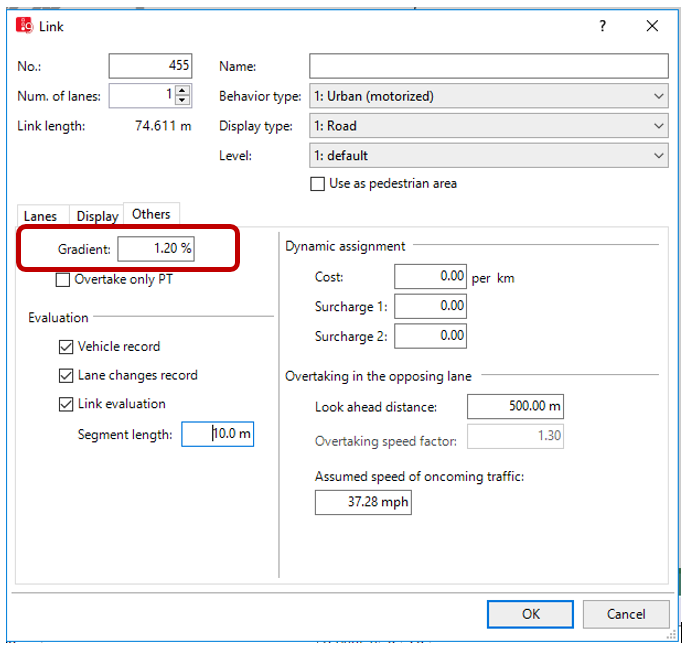
So, having defined the section lengths and the associated gradients, the next stage is to split the associated VISSIM links on the off-slip to replicate each of the sections and then apply the specific gradients to the links in the ‘Other’ tab within Link Attributes (as shown in Figures 4 and 5 below).

Figure 4 – Split Link Sections in VISSIM

Figure 5 – Applying Gradients to Specific Links using ‘Other’ Tab

This process can then be repeated for all sections where gradients are required to be modelled.

Final Comments

This methodology of modelling link gradients has allowed PJA to develop microsimulation models which take into account gradients on the more critical links in the network and the potential impacts associated with them through the power and acceleration / deceleration profiles.

It is acknowledged that this is not the only methodology for modelling gradients, but we feel it does provide a quick, simple and justifiable method in developing more realistic base models for validation.

As with other modelling elements, if more site specific data is available to evidence and justify adjustments to the gradient percentages used, then these should be considered and documented as part of the model development exercise.

Our Chairman Phil Jones has helped make history after Welsh Parliament passed a resolution to introduce a national 20 mph default speed limit.

In a world first, Welsh Ministers have voted in favour of proceeding towards landmark legislation in response to the final report from the Welsh 20mph Task Force Group, which was chaired by Phil.

The new speed limit will apply to restricted roads – those with street lights at least every 200 yards – and is expected to become law by April 2023.

Speaking in support of the motion, Lee Waters, the Deputy Minister for Economy and Transport, said: “The figures are stark and the figures are clear. The risk of being killed is almost five times higher in collisions between a car and a pedestrian at 30 compared to the same type of collisions at 20 – five times higher.

“The investment will reap rewards. Lives saved, costly accidents prevented, mental and physical health improved and the more intangible but equally valuable community fabric strengthened.”

Mr Waters added: I am hugely grateful to Phil Jones for leading this substantial piece of work over the last year, systematically identifying the barriers to implementing this significant change and drawing on the experience of the police, local authorities, public health experts and the key stakeholders to devise ways through.”

The Welsh Government will now launch 20 mph pilot areas to help them develop the guidance and tools needed for Wales as a whole.

The Welsh 20mph Task Force Group’s report included findings from international research showing that a 20mph limit on most urban roads and streets will result in fewer collisions and casualties, including a reduction in child deaths. It also found that the speed limit will lead to more walking and cycling, improvements in air quality and lower noise levels. In future it will be quicker and cheaper to roll out 20mph limits over wide areas as local authorities will only need identify the far fewer sections of road where a higher speed is justified. Recommendations on implementing and enforcing the new speed limit, as well as engineering, marketing and evaluating the success of the legislation are also included.

Phil said: “I am naturally delighted at the Welsh Parliament’s decision to introduce this fundamental change. As with previous ground-breaking initiatives such as the Active Travel Act and the Organ Donor Register, Wales has made history by becoming the first country to introduce a 20mph default speed limit for urban areas. We know that governments around the world will be closely watching as the legislation is introduced.

“A 20mph speed limit will mean safer streets and will also encourage more walking and cycling for everyday journeys – which is especially important during the Covid-19 pandemic where people are being discouraged from using public transport. Cars travelling at slower speed will also create a more pleasant environment for residents, bringing long term community benefits too.

“I would like to thank the Task Force Group members, which included representatives of local government and transport providers as well as passionate campaigners such as Rod King MBE, founder of 20’s Plenty for Us, and academic experts such as Adrian Davis for helping pave the way for this national law change.”

The campaign for 20mph default limit was supported by several Welsh organisations and NGOs including the Institute for Welsh Affairs, Public Health Wales, Sustrans Cymru, Royal College of Paediatrics and Child Health, Living Streets Cymru and BRAKE.

The report from the Welsh 20mph Task Force Group can be read here.

We are delighted to have opened an office in Manchester city centre, in the UK, appointing transport planning expert Chris Sibthorpe as director.

The new North West office responds to a surge in enquiries for advice on adapting streets to facilitate more cycling and walking, which has boomed during Covid-19 as people socially distance. The Government has launched a £2bn package to fund the changes to active travel infrastructure, which includes widening pavements, introducing new cycle lanes and safer junctions.

Well-respected Chris joins from Mott McDonald, where he led the Manchester transport planning team and has experience of working on projects across the North West, as well as an understanding of the region’s transport challenges.

He most recently worked on a project to promote active travel at Heathrow Airport as well as projects with Transport for Greater Manchester’s strategy and policy teams. He was also the project director for Greater Manchester’s Streets for All Orbital project which redesigned streets to make them more people friendly.

Chris will lead both the new PJA office and the company’s active travel division.

Nigel Millington, joint managing director at PJA, said: “We have been at the forefront of active travel delivery in the UK for many years through advising public and private sector clients as well as Government bodies including British Cycling, the Active Travel Consortium and the Cycle Proofing Working Group. We also edited the key Manual for Streets 1 and 2 publications and the Welsh Government’s Active Travel Design Guidelines and developed Local Cycling and Walking Infrastructure Plans.

“We have been looking to expand in the North West as part of our growth strategy, and with the recent rush in client demand this is the right time. While Covid-19 has posed challenges to some areas of our market, we have a positive attitude moving forwards and are fully committed to delivering for our clients.

“Chris’ passion for active travel across a range of settings as well as his knowledge and contacts in the region makes him the ideal candidate to take the helm. We look forward to him growing our presence and expanding our team of consultants.”

Chris added: “Local authorities and developers are keen for a Green restart to the economy and to not replace one health issue with another in the form of a return to damaging levels of air pollution and lost productivity associated with unchecked traffic growth. Increasing the proportion of people using active travel modes is going to be key to achieving this, building on the momentum for travel behaviour change arising from the pandemic. I am very much looking forward to advising clients on the temporary and permanent changes that can be made, as well as offering PJA’s wider expertise in transport planning, placemaking and engineering.

“PJA is well respected and leads the conversation in our industry on active travel so joining the organisation was a no-brainer for me. It shares my passion for developing well thought out schemes and takes a design-led approach, ensuring that its solutions enhance local character and provide a sense of place. The company delivers good quality products for its clients and I’m thrilled to be joining the team and growing PJA’s service offering in the north.”

The address of PJA Manchester is: 3 Piccadilly Place, Manchester, M1 3BN
Chris can be contacted at [email protected] / +44 (0) 7783 809574.

Carrying on PJA’s series of technical blogs for microsimulation modelling, our next topic focuses on the modelling of flares and merges in urban areas.

As with all of our technical posts, we acknowledge that these are not ‘set-in-stone’ methodologies and other techniques and processes may exist. However, we want to share our current processes to encourage feedback and improvement, as well as providing some guidance for those looking for a starting point on specific modelling methodologies.
It should also be noted that these behaviours were first developed using VISSIM version 10. If you are developing these behaviours in later versions of VISSIM, the dynamic assignment tab layouts may be slightly different to those in this post. However, the parmeters to change to replicate this behaviour remains the same.

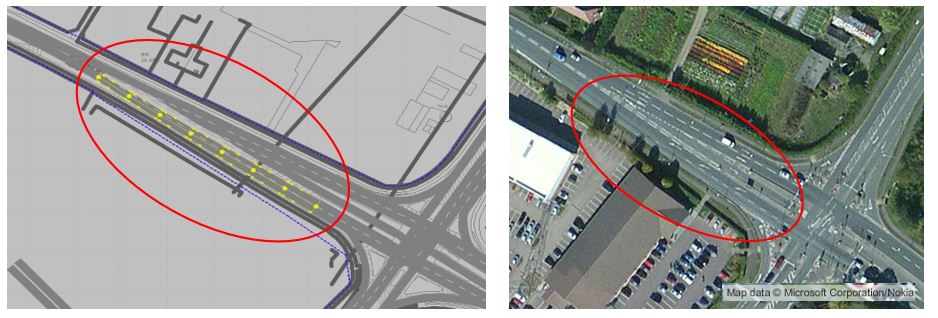
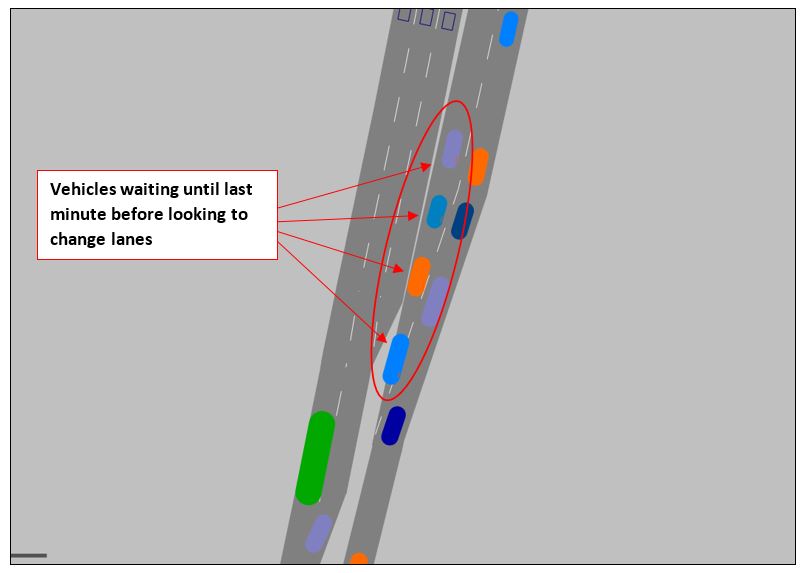
For VISSIM models developed in urban environments, there is a need to use additional driving behaviour profiles for locations where flares and merges exist (see Figures 1 and 2 below).


Figure 1 – Flare Example Replicated in VISSIM


Figure 2 – Merge Example in VISSIM

The additional behaviours allow for more realistic vehicle interaction and more representative modelled outputs in terms of queuing on approaches to junctions and junction exit capacity.

Additional Driving Behaviour – ‘Urban (flare)’
This behaviour is used on the approach to and around various junctions in an urban environment, with the purpose of the behaviour being able to prevent artificial capacity from vehicles moving into the flaring lane too early.

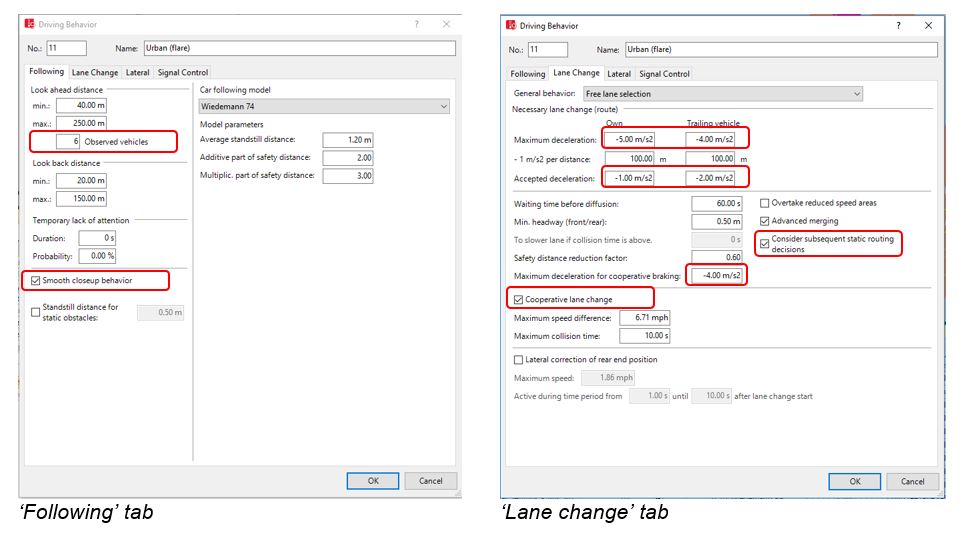
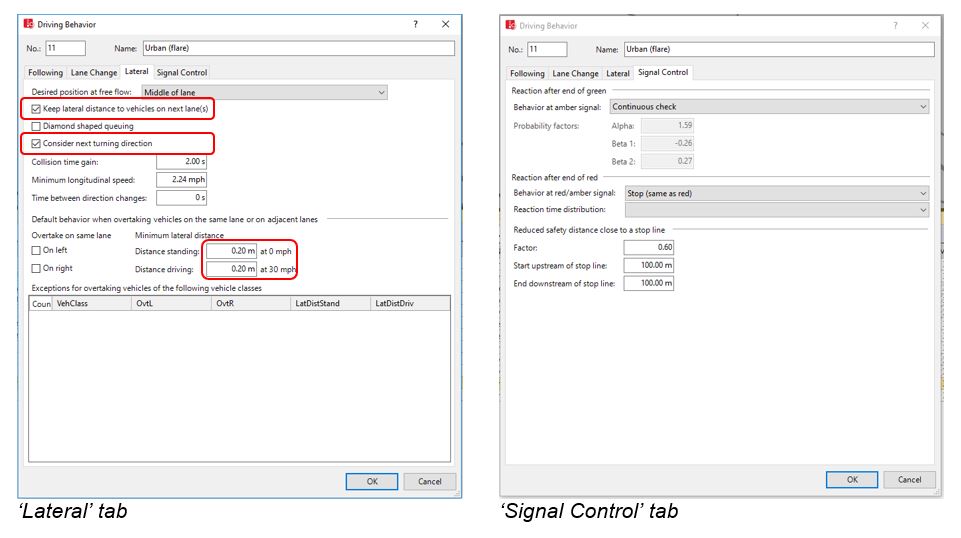
To create this behaviour, a duplication of the ‘Urban (motorised)’ behaviour was made, with the parameters changed within the Following, Lane change and Lateral tabs to ensure vehicles only moved into the second lane when there was space to do so. The behaviour configuration is shown in more detail in Figure 3 and the changes highlighted in red.


Figure 3 – Urban (flare) – Driver Behaviour Parameters

Figure 4 shows the result of using the new behaviour against the default Urban (motorised) settings.

Additional Driving Behaviour – ‘Urban (merging)’
‘Urban (merging)’ behaviour has been created to replicate more aggressive merging in sections where the carriageway merges from two lanes to one. This behaviour also encourages vehicles to change lanes earlier, preventing large numbers of queuing vehicles which do not change lanes until the emergency stop distance of the downstream connector. An example of this is shown in Figure 5.


Figure 5 – Merging Behaviour using Urban (motorised)

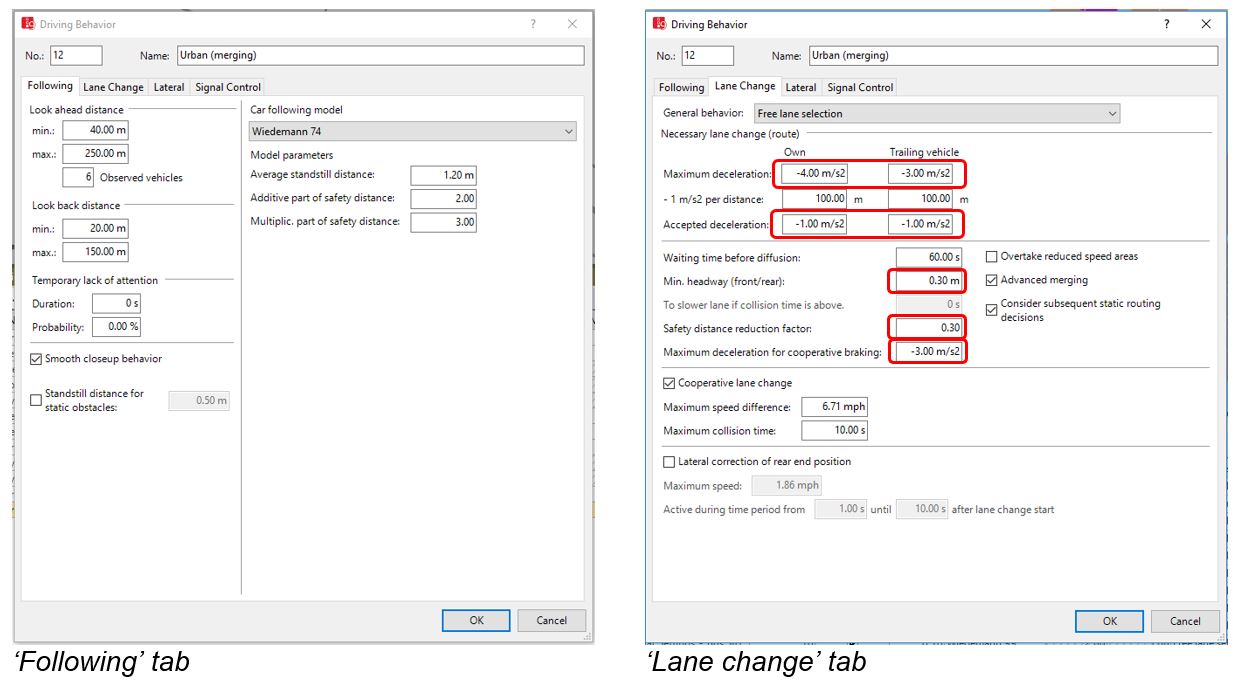
To create this behaviour, a duplication of the ‘Urban (flare)’ behaviour was made, with the parameters changed within the lane change and lateral tabs to make vehicles change lanes more co-operatively and cause vehicles in the nearside lane to give-way and let merging traffic into the main traffic flow.

The parameter changes have been made from reviewing PTV’s VISSIM Examples within the ‘Help’ file, with the ‘Inside Merge’ model a particular reference.

The behaviour configuration is shown in Figure 6 and the changes highlighted in red.

Figure 6 – Urban (merging) – Driver Behaviour Parameters

Figure 7 shows the result of using the new behaviour against the default Urban (motorised) settings.

Final Comments

The use of the Urban (flare) and Urban (merging) driver behaviour has allowed PJA to develop urban microsimulation models which take into account flare and merge areas and the capacity constraints associated with them.

It is acknowledged that this is not the only methodology for modelling these road layout elements, but we feel it does provide a useful starting point in developing a base model for calibration and validation.

As with other modelling elements, if local, site specific data is available to evidence and justify adjustments to the parameters, then these should be considered and documented as part of the model development exercise.


PJA’s latest technical blog focuses on the use of speed distributions for different turning radii in microsimulation models. This follows on from the previous Dynamic Assignment, Convergence and Speed Distributions topics.

As with all of our technical posts, we acknowledge that these are not ‘set-in-stone’ methodologies and other techniques and processes may exist. However, we want to share our current processes to encourage feedback and improvement, as well as providing some guidance for those looking for a starting point on specific modelling methodologies.

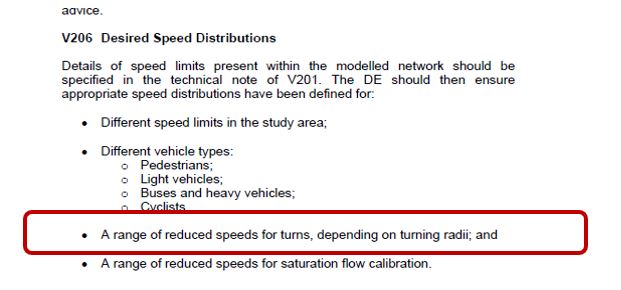
This post focuses on the need to consider appropriate reduced speed areas for turns and then their associated speeds when developing microsimulation models.

Transport for London’s (TfL) Modelling Guidelines suggest that speed distributions used for turns should be dependent on the turning radii (see figure below).

Whilst the DfT and TfL free flow speed distributions can be utilised, we have reviewed other guidance to understand if there are other means of calculated more appropriate speeds for turning radii.

Our research led us to two main sources – Design Manual for Roads and Bridges (DMRB) and the Chartered Institute of Highways & Transportation’s (CIHT) Manual for Streets 2. From these documents, we followed two main steps.

**It is acknowledged that the DMRB has recently been updated and the new documents are now available online. However for the purposes of this blog post, reference is made to the previous TD 42/95.  A review of the new documentation and any associated update to this post will follow in due course.**

Step 1 – Minimum Corner Radii identified from DMRB

TD42/95 from the DMRB suggests that the following radii should be a minimum for large goods vehicles for turning manoeuvres at junctions. We based our calculations on a large goods vehicle as this would provide a worst case for the road network modelled.

Simple Junction – Urban Area – No HGV provision = 6 m
Simple Junction – Rural Area – No HGV provision = 10 m
Simple Junction – Urban Area – With HGV provision = 10 m
Simple Junction – Rural Area – With HGV provision = 15 m
Ghost Island Junction – With HGV provision = 15 m
Staggered Junction – With HGV provision = 15 m
All other circumstances = 20 m

From these figures, we were able to determine that for different junction types, the highest braking / lowest speed distributions would be required for radii between 6m and 20m.

Step 2 – Calculate Design Speeds for Minimum Corner Radii

From Chapter 8.3 of Manual for Streets 2, design speeds were determined for the minimum corner radii derived from TD42/95.

Therefore, applying the V²/R value of 56 to the minimum corner radii from TD42/95, the following design speeds have been determined

Speed Radius (m)
6 10 15 20 25 30 35 40 45 50 55 60 65 70
kph 18.33 23.66 28.98 33.47 37.42 40.99 44.27 47.33 50.20 52.92 55.50 57.97 60.33 62.61
mph 11.39 14.71 18.01 20.80 23.25 25.47 27.51 29.41 31.19 32.88 34.49 36.02 37.49 38.91

[Additional radii have been included to determine design speeds for other corner-speed profiles]

To fit in with our Standard VISSIM Template, corner desired speed distributions were split into three categories – Low Braking, Medium Braking and High Braking.

As a result, the following split of the results above have been chosen.

These speed distributions formed the basis of the turning radii speeds included within the VISSIM model and allowed individual turns measured (e.g. from OS Mapping in DWG format) to be assigned to an appropriate speed profile.

Final Comments

The use of the DMRB and Manual for Streets 2 Guidance has allowed PJA to develop an evidenced methodology in determining appropriate speed distributions for the associated turning radii.

It is acknowledged that this is not the only methodology available for identifying suitable speeds, but we feel it does provide a useful starting point in developing a base model for calibration and validation.

As with other modelling elements, the use of more local, site-specific data should always take president, if this data is available and able to be analysed appropriately.


We would like to reassure all our clients and partner organisations that PJA will be able to provide continuity of service throughout this period of home working and social distancing.

Due to the ongoing investment in our systems and as part of our existing commitment to flexible working, our IT infrastructure and project data is already held in a cloud environment and the majority of our staff already use mobile devices, which means that our teams can work from anywhere.

We have put in place additional measures to allow those staff normally reliant on fixed workstations to work remotely, and we also have the ability to host client’s own project data on our secure cloud servers if need be.

Our staff are already used to collaborating on projects virtually using Microsoft Teams, both within and outside the business, and our management systems are also cloud-based, so we are fully capable of delivering for our clients throughout this period of uncertainty.

If there are any specific measures we can put in place to assist our collaboration with your business during this time, please feel free to speak to the senior management team at PJA.

We wish all our colleagues well in the weeks and months to come.

PJA is backing the London Collective – a new collaborative approach to city making which enables built environment experts and creatives to work together. Set up by Max Farrell, former partner at international design firm Farrells, the Collective provides a platform for self-employed and SME built environment entrepreneurs to join forces, whilst also working on their own projects.

Since its establishment in November 2019, the organisation already has 28 members and is involved in several and commissions for UK and international clients. Max explained: “Our members have knowledge, experience and contacts covering politics, property and placemaking. As  entrepreneurs we can tailor-make teams without the overheads, enabling us to convene and disband teams for place-based campaigns, like a film’s cast and crew. “

PJA chairman and Collective member Phil Jones added: “The London Collective is a hugely powerful idea. Cities are enormously complex places but making them successful and sustainable is of vital importance. The range of skills on offer and the agility with which it can work means the Collective can play its part in achieving that goal.”